Executive ghostwriter: agency or freelancer?
· 5 min read
A freelancer or an agency to write your executives' LinkedIn posts? Six questions that decide it, what each option does well, and what to ask before you sign.
Choose a freelance executive ghostwriter when one leader needs a steady writer, the themes are already clear and someone in-house owns approvals and measurement. Choose an agency when several leaders need to tell one story, when the themes still have to be defined and tied to business goals, or when continuity, compliance reviews and reporting matter. Either way, the ideas and the final approval stay with the executive.
Key takeaways
- The choice turns on six questions: access to the executive, strategy, voice, continuity, confidentiality and approvals, and measurement.
- A freelancer fits one executive with clear themes and an in-house owner for approvals and reporting.
- An agency fits several leaders, themes that still need defining, or approval chains with legal and investor relations.
- In the 2024 Edelman and LinkedIn study, only 15 percent of B2B buyers rated the thought leadership they read as very good or excellent.
- Producers named insufficient resources (50 percent), too little engagement from senior experts (27 percent) and missing skills (26 percent) as their main barriers.
An executive ghostwriter turns a leader's thinking into posts, articles and speeches the leader is happy to sign. Whether you hire a freelancer or an agency matters less than what you need around the writing: who sets the themes, who gets time with the executive, who keeps the voice consistent and who shows that the work moves the business. Here are six questions to decide, and what to ask before you sign.
What does an executive ghostwriter actually do?
Good ghostwriting starts with listening. The writer interviews the executive in short, regular sessions, turns the ideas into drafts in the executive's voice, and the executive edits and approves every piece. The opinions and the experience stay the executive's. So do the replies to comments: in the H/Advisors Gauly study of newly appointed CEOs in Germany (July 2026), CEOs who replied to comments got 77 percent more interactions than those who did not.
The bar is high. In the 2024 Edelman and LinkedIn B2B Thought Leadership study of 3,500 decision-makers, only 15 percent rated the thought leadership they read as very good or excellent. The pieces buyers rated highest had strong research and data (55 percent), helped them understand their own business challenges (44 percent) and offered concrete guidance and case studies (43 percent). Polished sentences alone do not get there. Research and the executive's own view do.
Freelancer or agency: which six questions decide it?
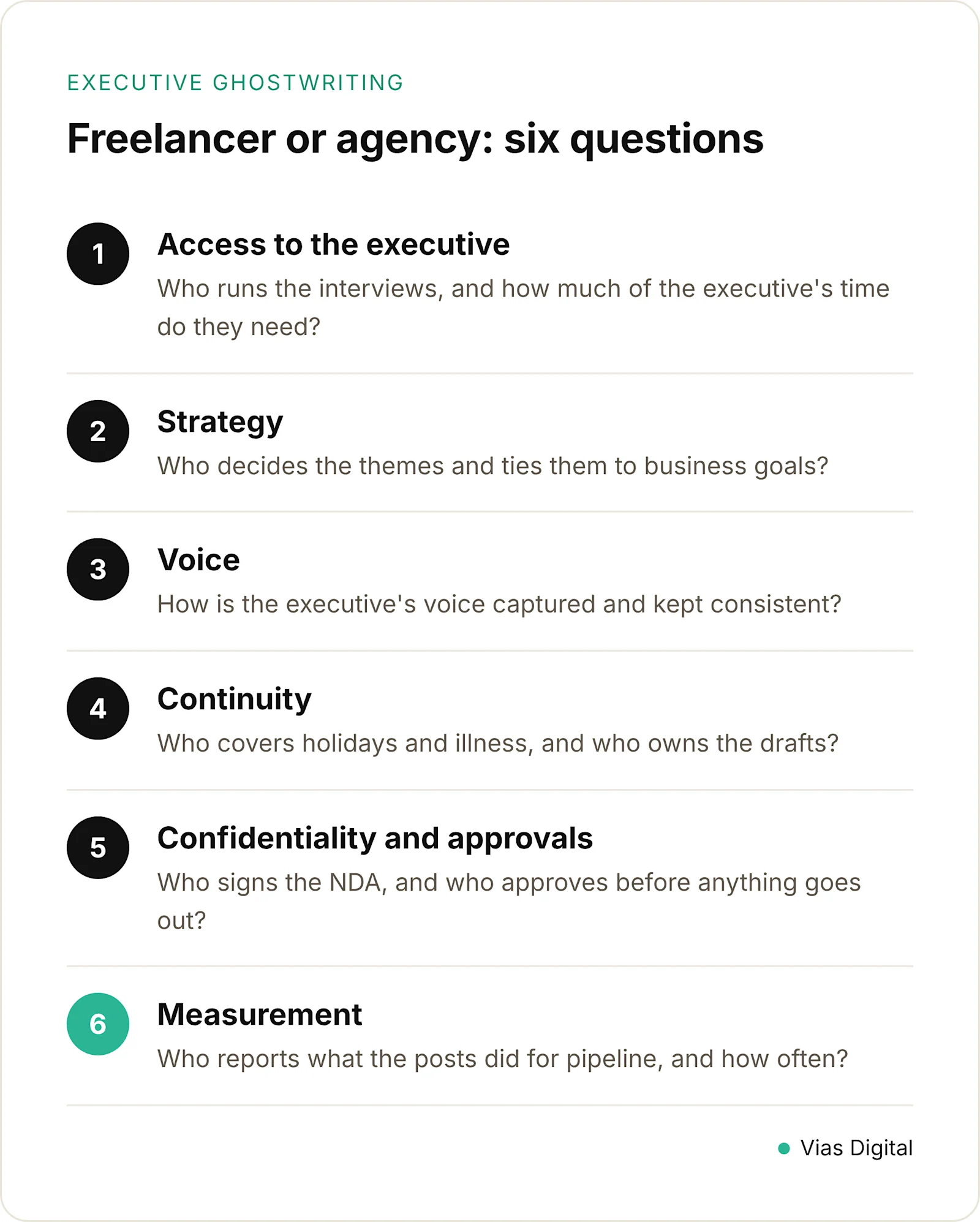
- Access to the executive. Who runs the interviews, and how much of the executive's time do they need?
- Strategy. Who decides the themes and ties them to business goals?
- Voice. How is the executive's voice captured and kept consistent across months and formats?
- Continuity. Who covers holidays and illness, and who owns the drafts and notes if you part ways?
- Confidentiality and approvals. Who signs the confidentiality agreement, and who approves before anything goes out?
- Measurement. Who reports what the posts did for pipeline, and how often?
Companies that produce thought leadership already know where it breaks. In the same Edelman and LinkedIn study, producers named insufficient resources (50 percent), a lack of engagement from senior experts (27 percent) and a lack of skills for high-quality content (26 percent) as their main barriers. Resources and skills can be hired. Executive time cannot, so whichever option you choose has to make the most of very little of it.
When is a freelance ghostwriter the right choice?
- You need one executive on LinkedIn, not a leadership team.
- The themes are set and tied to business goals already.
- Someone in-house approves, schedules and reports on every post.
- The executive and one specific writer work well together, and you accept the gap when that writer is away.
Ask a freelancer for samples written in voices other than their own, a plan for holidays and illness, and a confidentiality agreement before the first interview.
When is an agency the better choice?
- Several leaders, for example the CEO, the CFO and the head of sales, need to tell one story in their own voices.
- The themes still have to be defined and linked to commercial goals.
- Posts need review by legal, compliance or investor relations before they go out.
- The programme has to keep running through holidays, illness and staff changes.
- You want monthly reporting against pipeline, not a count of likes.
An agency also makes sense when the executive's posts are part of a wider plan, such as an employee advocacy programme or a broader executive communications strategy.
What should you ask before you sign?
The same six questions work for a freelancer and an agency. Put them in writing and compare the answers side by side.
How do you measure whether ghostwritten content works?
Not by likes. In the 2024 Edelman and LinkedIn study, only 29 percent of producers could link sales leads or business wins back to specific thought leadership, and 19 percent had no process for measuring it at all. Agree three signals before the first post: reach among decision-makers at your target accounts, conversations the content started, and opportunities in your CRM where a contact engaged with the executive's posts. Our three-signal log shows one way to track them month by month.
Where should you start?
With the themes. Any writer, freelance or agency, can only sound like your executive once you know what the executive stands for. Our guide to thought leadership strategy shows how to pick three. If they are still open, the Executive Narrative Sprint builds the executive narrative in 14 days. How we run executive ghostwriting, from the first interview to the monthly report, is on our executive thought leadership pages.
Frequently Asked Questions
Is it acceptable for an executive to use a ghostwriter?
Yes, if the ideas and opinions are the executive's and nothing is published without their approval. The ghostwriter structures and words the thinking. The executive edits, signs off and answers comments personally.
What is the difference between a freelance LinkedIn ghostwriter and an agency?
A freelance ghostwriter is usually one writer working for one or a few executives. An agency adds strategy, several writers, editing, approvals and reporting, and can keep several leaders on one story. Which you need depends on how many leaders you have and who owns strategy and measurement in-house.
How much of the executive's time does ghostwriting need?
Less than writing alone, but never zero. Plan for regular short interviews, quick reviews of drafts and personal replies to comments. Without that time, no writer can sound like the executive.
How do you keep a ghostwritten voice authentic?
Capture the voice before writing: record the interviews, collect the executive's own phrases and opinions in a short style guide, and let the executive edit every draft. Over time the edits get smaller.
Want this for your leadership team?
One 20-minute call with us. We go through your story and your proof, and tell you where we would start.
Sources
- Reaching Beyond the Ready: How Thought Leadership Gets Out-of-Market B2B Buyers Back into the Game (2024 Edelman-LinkedIn B2B Thought Leadership study; opened 19 Oct 2026), Edelman
- Alles auf Anfang: Whitepaper zur CEO-Kommunikation beim Amtsantritt (60 CEO-Wechsel 2024 und 2025; opened 16 Nov 2026), H/Advisors Gauly (Gauly Advisors GmbH)
Keep reading
- Thought Leadership Strategy for B2B Leaders: Themes, Plan and Measurement
A practical thought leadership strategy for commercial leaders at established B2B companies with low public visibility. Three themes, a plan in four phases and a way to measure it in your CRM.
- B2B brand strategy: how to build a position your market can verify
For CEOs and CMOs after an acquisition, a new owner or a new market: how to build a B2B brand position on dated evidence, with a six-part positioning worksheet and five signs your positioning has drifted.
- Generative engine optimization for B2B: what leadership should own
Before you hire a GEO agency, decide what stays with leadership. An own vs outsource split and six questions to ask any generative engine optimization partner.
By Raluca Baciu, Vias Digital. More in our insights.
About the author
Raluca Baciu, Founder, Vias Digital
#1 Branding voice in Switzerland on LinkedIn (Favikon 2026)
Raluca Baciu founded Vias Digital in Zurich after about 15 years in communications for B2B, technology and healthtech companies. At a listed company she led CEO visibility, the global customer community and corporate social media, and she ran her own digital agency for about seven years.
Topics
Executive Communications
You speak directly with us.