Generative engine optimization for B2B: what leadership should own
· 8 min read
Before you hire a GEO agency, decide what stays with leadership. An own vs outsource split and six questions to ask any generative engine optimization partner.
Generative engine optimization (GEO) is the work of making sure AI assistants such as ChatGPT, Perplexity and Google's AI Overviews describe your company accurately and cite it when buyers ask about your category. When you buy generative engine optimization services, leadership keeps positioning, core facts and approvals, while a partner runs audits, page fixes, third-party presence and monthly tracking. Nobody can guarantee AI citations, so Vias Digital advises hiring for method and transparent reporting.
Key takeaways
- GEO shapes how AI assistants describe and cite your company; the term comes from a 2023 research paper published at KDD 2024.
- Leadership owns positioning, entity facts, approvals and priorities; a GEO partner can run audits, page fixes, third-party presence and monthly tracking.
- Google says AI Overviews and AI Mode need no special files, markup or optimizations beyond the fundamentals of Search.
- Blocking OAI-SearchBot removes your site from ChatGPT search answers, so crawler access is the first technical check.
- Any agency that guarantees AI citations is overpromising; ask for raw answers, a fixed question set and competitor benchmarks instead.
What is generative engine optimization?
Generative engine optimization (GEO) is the practice of shaping your content, company facts and third-party presence so that AI assistants mention and cite your company accurately. The term comes from a research paper by Aggarwal and colleagues, first posted on arXiv in November 2023 and published in the KDD 2024 proceedings.
The paper found that targeted content changes could boost visibility in generative engine responses by up to 40 percent. Adding citations, quotations and statistics helped. Keyword stuffing, a staple of older SEO, performed poorly, and the effect of each tactic varied by domain.
For a B2B company, GEO comes down to three questions. Are we named when buyers ask about our category? Are we described correctly? Which sources does the assistant rely on? How a partner runs this work is described on our generative engine optimization page.
Why does AI search visibility matter to a B2B leadership team?
Because the first round of research is moving into the answer itself. Pew Research Center tracked the browsing of 900 US adults in March 2025. In its sample, 18 percent of Google searches produced an AI summary.
When people saw an AI summary, they clicked a traditional search result in 8 percent of visits. Without a summary, they did so in 15 percent of visits. A link inside the AI summary was clicked in just 1 percent of visits.
These are consumer numbers, not B2B buying data, but the direction is hard to ignore. Gartner predicted in February 2024 that traditional search engine volume would drop 25 percent by 2026 as people turn to AI chatbots and other virtual agents. That is a forecast.
That is why AI search visibility is a leadership topic. The assistant repeats what the market says about you. If your positioning is vague or your facts are inconsistent, that is what gets repeated, often before a buyer ever reaches your website.
How do ChatGPT, Perplexity and Google decide which companies to mention?
None of them publishes its full selection logic. What is documented is enough to set the ground rules.
- Google: According to Google Search Central, there are no additional requirements or special optimizations needed to appear in AI Overviews or AI Mode. A page must be indexed and eligible to show in Search with a snippet. There is no special schema.org markup for AI features. Both features may run multiple related searches across subtopics (query fan-out), which can surface a wider set of supporting links.
- ChatGPT: OpenAI uses OAI-SearchBot for ChatGPT's search features. OpenAI states that sites opted out of OAI-SearchBot will not be shown in ChatGPT search answers. GPTBot is a separate crawler related to model training.
- Perplexity: PerplexityBot is designed to surface and link websites in Perplexity's search results, and Perplexity recommends allowing it in robots.txt.
None of this is a secret lever. The basics decide: pages that can be crawled, clear answers to buyer questions, consistent company facts, and credible sources that mention you.
What should leadership own, and what can a GEO agency run?
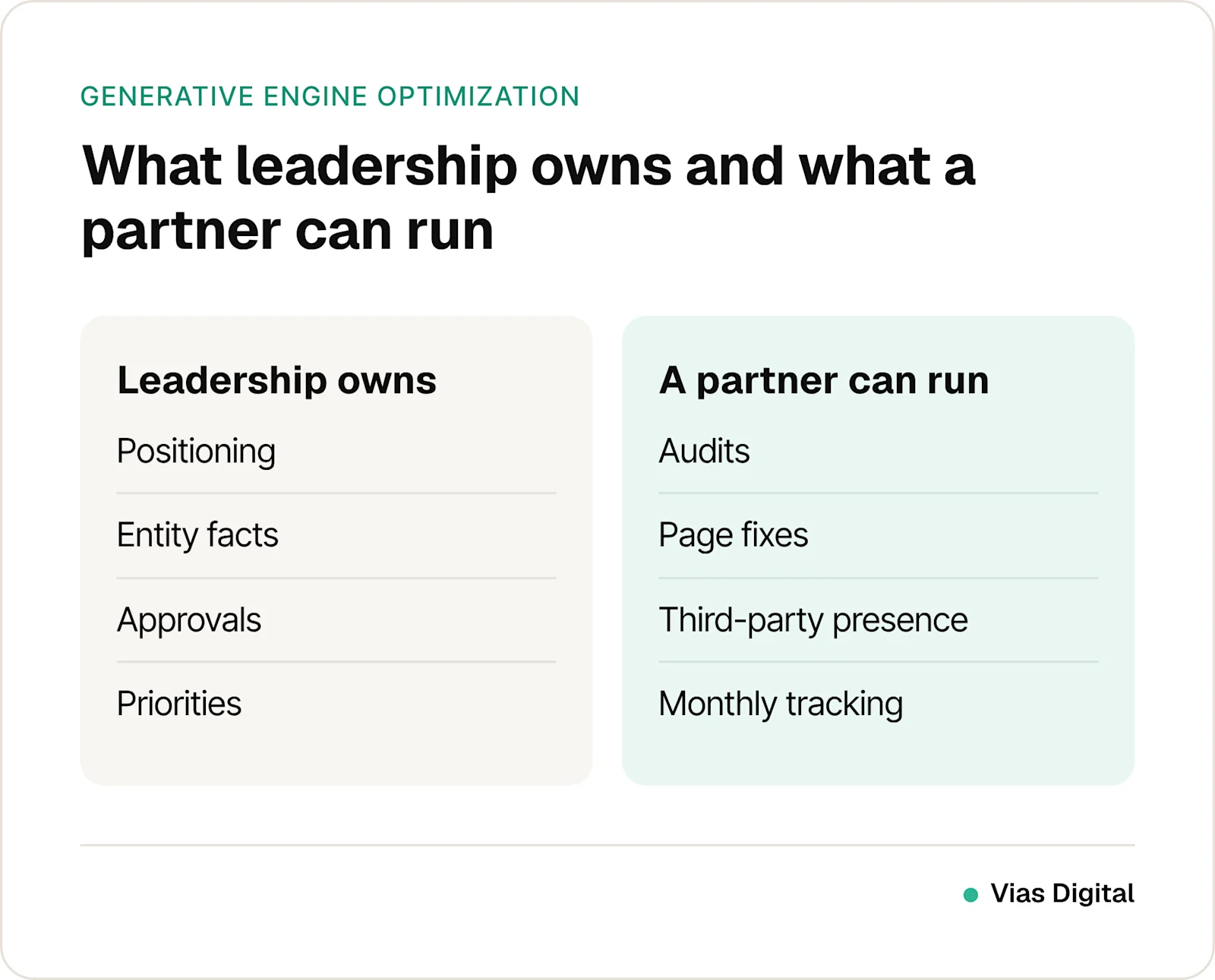
The split below works for most mid-sized B2B companies. The rule of thumb: leadership owns anything that defines what the company is and what it claims. A partner can run anything that is method, execution and measurement.
What leadership must own
- Positioning: What the company does, for whom, and why it wins. GEO amplifies whatever positioning exists. It cannot invent one.
- Entity facts: One approved company description plus the core facts: legal name, locations, offer, industries served, ownership and leadership. These must match across your website, LinkedIn, directories and press materials. Assistants also describe your executives, so their profiles and executive thought leadership belong in the same review.
- Approvals: Who signs off on claims, case studies, figures and customer names. In regulated or technical markets this is usually the bottleneck, so settle it before work starts.
- Priorities: Which buyer questions, markets and languages matter most, and which competitors you benchmark against.
What a partner can run
- Audits: A baseline across a fixed set of buyer questions and assistants, compared with your main competitors, plus a technical check of crawler access and indexing.
- Page fixes: Rewriting or creating service and category pages so they answer buyer questions directly and with evidence, and adding Organization structured data where it is missing.
- Third-party presence: Correcting directory and association listings, placing expert articles in trade media, and building reference cases with customers.
- Monthly tracking: Repeating the same questions every month, logging mentions, accuracy and cited sources, and reporting the trend against competitors.
What questions should you ask a generative engine optimization agency?
Use these six questions in any agency conversation. The answers will tell you more than a case study slide.
1. What do you guarantee?
The honest answer is that nobody can guarantee AI citations. Answers depend on the model, the search index behind it, the exact question and the moment it is asked. Even Google's documentation notes that meeting its requirements does not guarantee a page will be crawled, indexed or served.
A good agency guarantees its process, its deliverables and transparent reporting. If someone guarantees placement in ChatGPT or Perplexity, keep looking.
2. Which buyer questions will you track, and who approves the list?
The question set is the foundation of every measurement. It should come from your sales team and real buyer conversations, and leadership should sign it off. Ask to see it before any work starts.
3. What will the monthly report show?
Look for the raw answers behind any score: which assistant, which question, whether you were named, the exact wording, the cited sources, and the same data for your competitors. You should be able to check any number in the report yourself.
4. What will you change on our site, and what needs our approval?
Separate technical changes, such as robots.txt, structured data and indexing, from changes to what the company claims. Every claim change should go through your approval path.
5. How do you build third-party presence?
Credible presence comes from accurate listings, earned articles, association memberships and customer references. Ask how the agency avoids paid fake reviews, link schemes and mass-produced content, all of which put your reputation at risk.
6. Where do you start?
If the answer is a tool demo, be careful. GEO that starts from keywords produces pages. GEO that starts from positioning produces a company that is described the way it wants to be described. Ask how the agency will test your positioning before it rewrites anything.
How will you know generative engine optimization is working?
Expect leading indicators before revenue, and judge them as a trend rather than a single snapshot, because AI answers vary from one week to the next. A sound engagement should show movement on four measures:
- Mention rate: The share of your tracked questions in which you are named, per assistant.
- Accuracy: Fewer factual errors about your company in AI answers.
- Cited sources: More of your own pages and credible third parties among the sources the assistants cite.
- Competitive position: How your mention rate moves relative to the competitors you chose.
Then connect these to signals your sales team already sees, such as prospects who say they asked an AI assistant about your category, or first calls that start with a correct picture of what you do.
Is GEO separate from SEO?
No. Google's guidance for AI Overviews and AI Mode rests on the same fundamentals as Search. GEO builds on technical SEO and adds the questions SEO did not ask: how you are described, by which sources, and against which competitors.
In practice, the order of work matters. Fix crawler access and indexing first, because a page that cannot be crawled cannot be cited. Then make your core service pages answer buyer questions plainly, with evidence. Only then invest heavily in third-party presence, so that what others say about you points back to pages that state the same facts in the same words.
Where should you go from here?
At Vias Digital, GEO starts from positioning, and we track AI answers monthly inside our Market & Competitive Intelligence brief, so you can see how assistants describe you and your competitors over time. Read how we approach generative engine optimization, how we build B2B brand strategy, and what the Market & Competitive Intelligence brief covers.
Frequently Asked Questions
What is generative engine optimization?
Generative engine optimization (GEO) is the practice of making your company easier for AI assistants such as ChatGPT, Perplexity and Google's AI features to find, describe accurately and cite. The term was introduced in a 2023 research paper by Aggarwal et al., later published at KDD 2024. It builds on SEO but focuses on generated answers rather than ranked links.
Can a GEO agency guarantee that ChatGPT will recommend us?
No. AI answers depend on the model, the search index behind it and the exact question, and they change over time. A credible agency guarantees its process, deliverables and transparent reporting, not citations. Treat any guaranteed placement as a red flag.
Do we need an llms.txt file or special schema markup for AI search visibility?
Not for Google. Google Search Central states that AI Overviews and AI Mode require no new machine-readable files, no AI-specific text files and no special schema.org markup. Organization structured data on your home page is still useful because it helps Google understand and disambiguate your company.
How do you measure AI search visibility?
Define a fixed set of buyer questions, ask them in each assistant you care about, and record whether you are named, how you are described and which sources are cited. Run the same questions for your main competitors. Repeat the exercise monthly, because single samples vary too much to guide decisions.
What should leadership own in a GEO project, and what can an agency run?
Leadership owns what defines the company: positioning, the approved core facts, sign-off on claims and figures, and the priority buyer questions, markets and competitors. A partner can run the audit, page fixes, third-party presence and monthly tracking.
How do you know generative engine optimization is working?
Track four measures as a trend over several months: the share of tracked questions where you are named, fewer factual errors about your company, more of your own pages and credible third parties among the cited sources, and your mention rate against the competitors you chose.
Want this for your leadership team?
One 20-minute call with us. We go through your story and your proof, and tell you where we would start.
Sources
- GEO: Generative Engine Optimization (arXiv:2311.09735, KDD 2024), Aggarwal et al., arXiv (submitted 2023-11-16, v3 2024-06-28)
- AI features and your website, Google Search Central (last updated 2025-12-10)
- Overview of OpenAI Crawlers, OpenAI
- Perplexity Crawlers, Perplexity
- Google users are less likely to click on links when an AI summary appears in the results, Pew Research Center (2025-07-22)
- Gartner Predicts Search Engine Volume Will Drop 25% by 2026, Due to AI Chatbots and Other Virtual Agents, Gartner (2024-02-19)
Keep reading
- B2B brand strategy: how to build a position your market can verify
For CEOs and CMOs after an acquisition, a new owner or a new market: how to build a B2B brand position on dated evidence, with a six-part positioning worksheet and five signs your positioning has drifted.
- Thought Leadership Strategy for B2B Leaders: Themes, Plan and Measurement
A practical thought leadership strategy for commercial leaders at established B2B companies with low public visibility. Three themes, a plan in four phases and a way to measure it in your CRM.
- How a leadership team can monitor competitors in 30 minutes a week
A 30-minute weekly routine, minute by minute, for leadership teams that want to follow competitors without building a department.
By Raluca Baciu, Vias Digital. More in our insights.
About the author
Raluca Baciu, Founder, Vias Digital
#1 Branding voice in Switzerland on LinkedIn (Favikon 2026)
Raluca Baciu founded Vias Digital in Zurich after about 15 years in communications for B2B, technology and healthtech companies. At a listed company she led CEO visibility, the global customer community and corporate social media, and she ran her own digital agency for about seven years.
Topics
AI Search Visibility
You speak directly with us.