Entering Germany, Austria and Switzerland: how to read the competitive landscape before you commit
· 9 min read
Before committing to Germany, Austria or Switzerland, map competitors from public registers, tenders, association lists and fairs. A step-by-step checklist.
To read the competitive landscape in Germany, Austria and Switzerland before you commit, map competitors from four public source types: commercial registers (handelsregister.de, the Austrian Firmenbuch, Zefix), tender portals (TED, simap.ch and national portals), industry association member lists such as VDMA and Swissmem, and trade fair exhibitor lists such as Hannover Messe.
Key takeaways
- DACH is three markets: Germany and Austria are in the EU, Switzerland is not and runs its own registers and tender platform.
- German register data has been free to retrieve since 1 August 2022.
- Austrian Firmenbuch data is mostly fee-based, with a free short summary per company.
- Association member lists and fair exhibitor lists show who you will actually meet: VDMA alone reports 3,500 member companies.
- Public tender award notices show who wins, at what value, against how many bidders.
Why read the DACH landscape before you commit?
Because the competitors you will face in Germany, Austria and Switzerland are often companies your US team has never heard of, and the public record about them sits in places a US playbook does not look.
DACH is shorthand for Germany (D), Austria (A) and Switzerland (CH). They share a business language, and that is where the similarity ends for planning purposes. Germany and Austria are EU members, price in euros and follow EU procurement rules. Switzerland is outside the EU, prices in Swiss francs, and runs its own register index and tender platform [5][12]. Each country has its own commercial register, with different rules on what is free and what costs money.
A privately held competitor publishes far less than a US listed company. The public record still says a great deal: who owns the company and who runs it, what it files, which public contracts it wins, which associations it belongs to and which fairs it exhibits at. The four source types below are where to read it.
Who will you actually compete against?
Start wide, with lists that companies put themselves on: industry association member lists and trade fair exhibitor lists. Then narrow down.
Industry associations. In machinery and plant engineering, VDMA describes itself as the largest industrial association in Europe, with 3,500 primarily medium-sized member companies in the capital goods industry, organised in 35 trade associations, and it publishes a member list on its site [6]. VDMA Austria reports 140 Austrian member companies [7]. In Switzerland, Swissmem, which describes itself as the leading association of the Swiss tech industry, offers a member directory (Mitgliederverzeichnis) on its website [8]. Read the member lists of the trade associations closest to your product, not the whole association.
A word you will meet often: Mittelstand. Germans use it for mid-sized, frequently family-owned companies, and VDMA's own description of its members as "primarily medium-sized" tells you how much of the industrial field looks like that [6].
Trade fairs. Exhibitor lists show who is investing to be seen in your category this year. Hannover Messe keeps an online directory of exhibitors and products, and its next edition runs from 5 to 8 April 2027 [9]. Search the directory by product category, note who exhibits, and compare it with the association lists. The overlap is your core competitive set. Your sector's specialist fairs will add names a broad fair may not show.
Public tenders. If public buyers purchase what you sell, award notices are the most direct evidence of who is winning. We cover this in the next section and in detail in tender monitoring in Europe and Switzerland.
What can public registers tell you about a competitor?
Ownership, legal structure, management and, in Germany and Austria, filed accounts. The rules differ by country.
Germany. The joint register portal of the federal states, handelsregister.de, covers the commercial, cooperative, partnership and association registers of all states, and publishes register announcements [1]. Since 1 August 2022, retrieving data and documents from the commercial register has been free of charge [2]. That makes it practical to pull the entry for every name on your list: legal form (GmbH is a limited liability company, AG a stock corporation), registered seat, managing directors and recent changes. For financial statements, German companies disclose their accounting documents through the Unternehmensregister, the central platform for company data [3]. How much detail you get depends on the company's size and legal form.
Austria. The Firmenbuch holds registration data in its main register and keeps documents, including the annual accounts of companies required to file them, in its document collection [4]. Access is mostly fee-based. A short summary per company (the "Kurzinformation") is free; full extracts and documents are paid products, available online through JustizOnline or through commissioned service providers [4].
Switzerland. Zefix, the central business name index maintained by the Federal Office of Justice, publishes daily updated core data on active legal entities in the commercial register, including company name, registered seat and address [5]. Use it to confirm the exact legal entity behind a brand and to spot new entities in your field.
One practical rule for all three: record each competitor's exact legal name and register number. Many groups operate through several entities, and award notices, filings and register changes appear under the legal name, not the brand.
What do public tenders show about demand and rivals?
Who buys, how much, and who wins. Contract award notices in the EU name the winning company, give the value of the winning tender or the highest and lowest tender considered, and state how many tenders were received [11]. TED, the EU's procurement journal, publishes over 3,000 notices every weekday and is free to search [10].
Germany and Austria publish above-threshold contracts on TED and add national channels for smaller ones; Austria, for example, makes core tender data available on data.gv.at, searchable through its business service portal [13]. Switzerland publishes invitations to tender and awards on its joint federal and cantonal platform, simap.ch, and access is free of charge by law [12].
For a US company, a year of award notices in your category is a market map with dates on it: which competitors win with which buyers, in which regions, at what contract sizes.
The pre-entry checklist
Work through it in this order. Each step narrows the field for the next one.
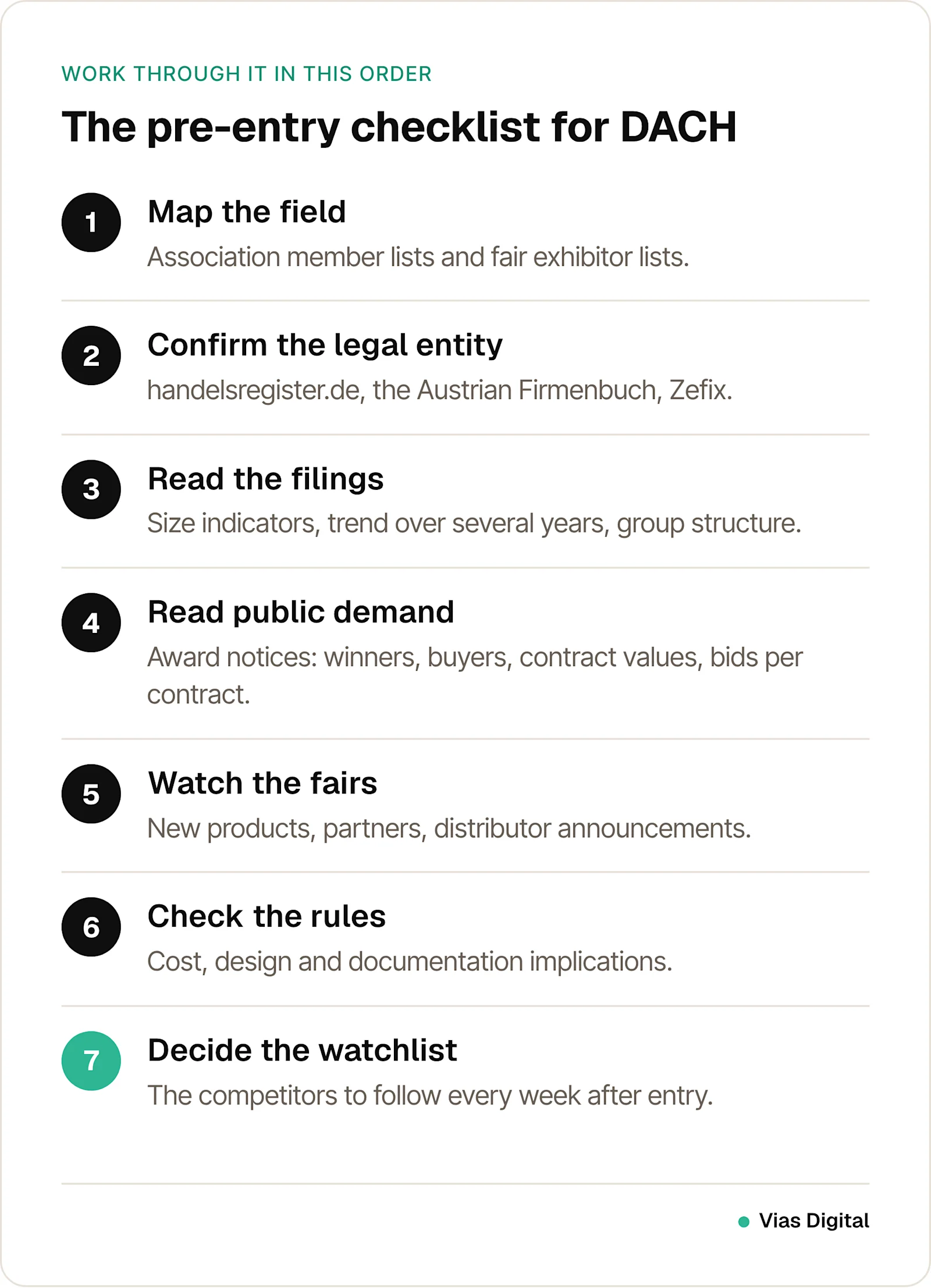
1. Map the field: who sells what we sell here?
- Germany: VDMA member list [6]; Hannover Messe exhibitor directory [9].
- Austria: VDMA Austria [7]; Austrian and EU fair lists.
- Switzerland: Swissmem member directory [8].
- Write down: a long list of names, with segment and home region.
2. Confirm the legal entity: who exactly is this company, and who runs it?
- Germany: handelsregister.de, free since 1 Aug 2022 [1][2].
- Austria: Firmenbuch, free short summary, paid extracts [4].
- Switzerland: Zefix core data, updated daily [5].
- Write down: legal name, register number, seat, managing directors, recent changes.
3. Read the filings: how big is it, and how is it doing?
- Germany: accounts disclosed via the Unternehmensregister [3].
- Austria: annual accounts in the Firmenbuch document collection [4].
- Switzerland: company publications and press where available.
- Write down: size indicators, trend over several years, group structure.
4. Read public demand: who buys, and who wins?
- Germany: TED and national portals [10][11].
- Austria: TED and data.gv.at core data via the USP [13].
- Switzerland: simap.ch, awards free to read [12].
- Write down: winners, buyers, contract values, bids per contract.
5. Watch the fairs: who is launching what, with whom?
- Germany: Hannover Messe, 5 to 8 April 2027 [9], plus sector fairs.
- Austria and Switzerland: sector fairs.
- Write down: new products, partners, distributor announcements.
6. Check the rules: which regulation reaches our product or its cost?
- Germany and Austria: EU rules, for example CBAM in its definitive regime since 1 January 2026 [14].
- Switzerland: Swiss rules, read separately.
- Write down: cost, design and documentation implications.
7. Decide the watchlist: which names matter most?
- All three markets: the competitors to follow every week after entry.
On step 6, one example with a fixed date: the EU's Carbon Border Adjustment Mechanism has applied in its definitive regime since 1 January 2026 to imports of cement, iron and steel, aluminium, fertilisers, electricity and hydrogen [14]. A US company shipping covered goods into Germany or Austria has a cost line to price in that a local competitor buying inside the EU may not. Our page on regulatory horizon scanning covers how to keep a leadership team ahead of rules like this.
What happens after the entry decision?
The checklist gives you a picture on one date. Once you are in the market, the picture moves: a competitor changes owner, a rival wins three utility contracts in a row, a distributor switches sides before a fair. The useful habit is a weekly read of the watchlist from step 7, using the same sources, so the leadership team in the US sees what changed in DACH before it shows up in the sales numbers. For industrial companies, our page on competitive intelligence for mid-sized manufacturers describes what that weekly read covers.
A weekly view of DACH from your desk
For a US leadership team, the hardest part of a new market is knowing what changed there this week without a local team to ask. Vias Digital is a Zurich provider of market and competitive intelligence for leadership teams of established B2B companies: a weekly, one-page brief on their competitors, markets, tenders and regulation, every fact linked to its source, starting at 2,500 CHF a month, with no platform to run and no one to hire. The languages of the sources and of the edition are set for each client, so a US team can follow German- and French-language sources in an English edition. Priorities are agreed at a 45-minute kickoff, and the first edition arrives within 48 hours. Market & Competitive Intelligence explains how it is set up around your markets.
Start the subscription: Starting at 2,500 CHF a month. A 6-month subscription. Cancel within the first 30 days for a full refund and nothing further owed.
Frequently Asked Questions
Is DACH one market?
No. Germany and Austria are EU members with euro pricing and EU procurement rules. Switzerland is outside the EU, prices in Swiss francs, and runs its own commercial register index (Zefix) and public procurement platform (simap.ch). Plan for three markets that share a language, not one.
Can I look up a German company's register entry for free?
Yes. Retrieval of data and documents from the German commercial register on handelsregister.de has been free of charge since 1 August 2022. The portal covers the commercial, cooperative, partnership and association registers of all federal states.
Where do I find a German competitor's financial statements?
German companies disclose their accounting documents through the Unternehmensregister, the central platform for company data. How much detail you get depends on the company's size and legal form, so treat the filings as a floor, not a full picture.
How do I find out who my competitors are in Switzerland?
Start with the Swissmem member directory if you are in machinery, electrical or metal products, then check each name in Zefix, which publishes daily updated core data on active legal entities. Award notices on simap.ch show which companies win Swiss public contracts in your category.
Which trade fair should a US industrial company visit first?
It depends on your sector. Hannover Messe's online directory of exhibitors and products is a useful starting point even before you travel, and its next edition runs from 5 to 8 April 2027. Add your own sector's specialist fairs as well.
Show me this for my company
A short walkthrough by video, in English (book your time now)
A sample edition for our sector within 48 hours
Show me this for my company · Book a walkthrough · Start the subscription
You speak directly with us.
Sources
- Registerportal: Gemeinsames Registerportal der Länder, handelsregister.de
- Änderungen bei Handelsregisterbekanntmachungen, IHK Frankfurt am Main
- Unternehmensregister: Die zentrale Plattform zu Unternehmensdaten, Unternehmensregister (Bundesanzeiger Verlag)
- Unternehmensregister in den EU-Ländern: Österreich, European e-Justice Portal
- Zefix: Central Business Name Index (dataset), opendata.swiss, Federal Office of Justice
- VDMA homepage: Largest industry network in Europe, VDMA
- VDMA Austria, VDMA
- Swissmem Verband: Porträt (navigation includes the Mitgliederverzeichnis), Swissmem
- HANNOVER MESSE homepage, Deutsche Messe AG
- About TED: The Online EU Procurement Supplement, Publications Office of the European Union
- Directive 2014/24/EU on public procurement, Article 50 and Annex V Part D, European Parliament and Council, EUR-Lex
- Federal Act on Public Procurement (PPA, SR 172.056.1), Art. 48 Publications (bilingual text; the Fedlex publication is binding), Swiss Confederation, via droit-bilingue.ch
- Auftrag bekanntmachen, Wirtschaftskammer Österreich (WKO)
- Carbon Border Adjustment Mechanism, European Commission, Taxation and Customs Union
Keep reading
- How a leadership team can monitor competitors in 30 minutes a week
A 30-minute weekly routine, minute by minute, for leadership teams that want to follow competitors without building a department.
- Contify, Valona and AlphaSense alternatives for mid-sized industrial companies
What Contify, Valona and AlphaSense each offer, who each is best for, and when a managed weekly brief or an in-house analyst is the better fit.
- Outsourced competitive intelligence: when it makes sense for a mid-sized company
Five signals that outsourcing competitive intelligence makes sense, three that it does not, and what a hire, a platform or a managed brief costs.
By Raluca Baciu, Vias Digital. More in our insights.
About the author
Raluca Baciu, Founder, Vias Digital
#1 Branding voice in Switzerland on LinkedIn (Favikon 2026)
Raluca Baciu founded Vias Digital in Zurich after about 15 years in communications for B2B, technology and healthtech companies. At a listed company she led CEO visibility, the global customer community and corporate social media, and she ran her own digital agency for about seven years.
Topics
Market & Competitive Intelligence, Market entry DACH
You speak directly with us.